Industry Insights & Manufacturing Knowledge
Expert guides, textile sourcing strategies, quality assurance tips, and international export trends from KK Fashion Exports.
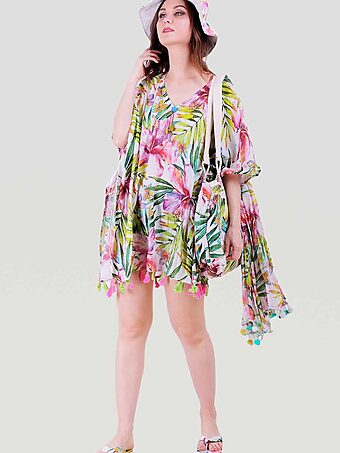
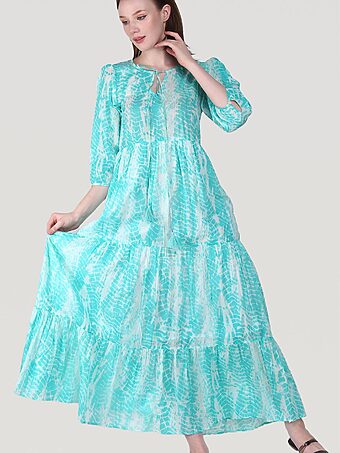
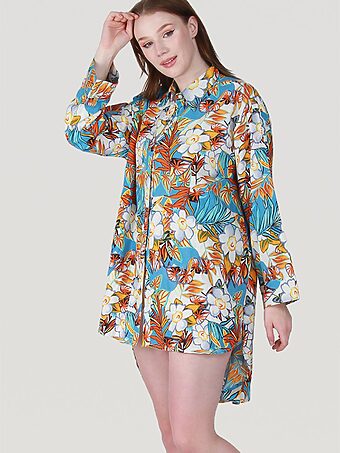
Engineered with high-tensile 30s/40s viscose yarn, precision digital reactive prints, and hand-finished tassels. Explore our export-ready wholesale items below.
An authoritative analysis of fiber selection, yarn density, tensile mechanics, and print longevity for wholesale resortwear procurement.
Rayon printed kaftans demand precise balance between lightness and opacity. Premium kaftan manufacturing relies on 30s Single Rayon (110–120 GSM) and 40s High-Twist Rayon (130–140 GSM). Lower yarn counts lead to fabric sagging, while uncalibrated density compromises thermal breathability.
Regenerated cellulose fibers yield a moisture regain rate of 11–13%, outperforming synthetic polyester in tropical climates. The bending rigidity score of our rayon twill and plain weave fabrics ensures fluid silhouette drape without electrostatic cling during extended wear.
We utilize Reactive Ink Rotary Printing and high-definition Digital Reactive Printing. Unlike cheap pigment overlays, reactive dyes bond chemically with the cellulose chain, achieving Grade 4+ Color Fastness to washing (ISO 105-C06) and light fastness (ISO 105-B02).
When wholesale apparel procurement officers evaluate fabrics for resortwear, beachwear kaftans, and loungewear lines, the structural performance of regenerated cellulose is paramount. Viscose Rayon is synthesized from natural wood pulp (typically eucalyptus, spruce, or bamboo), offering silk-like tactile softness at a fraction of raw silk procurement costs.
A crucial engineering parameter in kaftan manufacturing is **dimensional stability after wet processing**. Unprocessed rayon fibers exhibit high wet-hydrophilic expansion, leading to garment shrinkage up to 10–12% if unmanaged. At KK Fashion Exports, our manufacturing process integrates pre-shrinkage **Sanforization and Mercerization protocols**, reducing residual shrinkage to less than 3% (ISO 6330 test standards). This technical rigor prevents buyer disputes and guarantees consistent sizing across North American and European retail size specifications (XS to 5XL).
| Technical Parameter | Standard Rayon (Market Generic) | KK Fashion Premium Viscose | Polyester Blend (Low End) |
|---|---|---|---|
| Yarn Count & Weave | 24s Plain Weave | 30s / 40s Comb Viscose Twill & Plain | 75D Polyester Microfiber |
| Moisture Regain Rate | 8% - 9% | 11.5% - 13% (Superior Cooling) | 0.4% (Trap Heat & Moisture) |
| Color Fastness (Rubbing/Washing) | Grade 2-3 (Pigment Print) | Grade 4-5 (Digital Reactive Print) | Grade 3-4 (Disperse Print) |
| Tensile Strength (Warp x Weft) | 220N x 180N | 340N x 290N (Reinforced Seams) | 450N x 400N |
| Handfeel & Drape Index | Stiff / Rough finish | Ultra-Soft Silk Fluidity | Synthetic Plastic feel |
Deciphering consumer shift toward eco-responsible loungewear, artisanal digital fusion prints, and modular sizing vectors for global apparel buyers.
Global sustainability legislation (such as the EU Corporate Sustainability Due Diligence Directive) is driving brands away from untraceable viscose. Procurement managers are prioritizing kaftan manufacturers that utilize FSC (Forest Stewardship Council) certified wood pulp and low-emission closed-loop spinning technologies. Sustainable rayon reduces water consumption by 50% and carbon emissions by up to 40% compared to legacy viscose production.
Current consumer intent metrics reveal explosive demand for Bohemian prints, Mediterranean tile motifs, Indian block-print heritage designs, and tropical botanicals fused with contemporary geometric borders. High-precision 12-color digital reactive printing allows hyper-detailed gradient transitions and sharp line work without heavy screen setup charges, making short-run custom collections economically viable.
Retail inventory risk is a primary concern for wholesale buyers. Modern kaftan designs leverage adjustable drawstrings, butterfly sleeves, side slits, and convertible necklines (V-neck to off-shoulder). This inclusive engineering allows 2 or 3 SKU sizes to cover standard S through 3XL body types, dramatically slashing deadstock risks and simplifying warehouse logistics.
Fashion cycles have compressed from 6 months to 4-6 weeks. B2B buyers now mandate OEM partners capable of rapid prototyping (sample dispatch within 5–7 days) and flexible MOQs (100–300 pieces per style). Factories equipped with computerized pattern cutting and in-house digital sampling are capturing market share from legacy high-volume factories.
Operating from Noida, Uttar Pradesh, India. Fully compliant, ethically audited, and equipped for global supply chain integration.
Rigorously audited between 2017 and January 2026 by URS Verification Private Limited. Certified for Labor Standards, Health & Safety, Environmental Management, and Business Ethics.
Extensive archives of ready garment patterns, tech packs, screen designs, and embroidery templates. Accelerate time-to-market with zero pattern drafting delay.
Equipped with modern screen printing tables, automatic fabric cutting, vacuum thread trimmers, roller steam irons, and in-house needle detector machines.
4-Point System check for yarn slubs, weaving flaws, and GSM tolerance.
Spectrophotometer color matching under D65 standard lighting.
100% inspection for print bleed, registration alignment, and dye spots.
Lead-free, nickel-free testing for zips, buttons, drawcords, and tassels.
Verification of seam allowance, stitch density (8–10 SPI), and pattern fit.
Ongoing monitor on factory lines to correct tension or seam puckering.
Steam ironing inspection, measurement tolerance check (+/- 1cm).
100% metal detector scan before export packing to ensure safety compliance.
Essential insights for apparel buying houses, private label brands, and wholesale distributors sourcing Rayon Printed Kaftans from India.